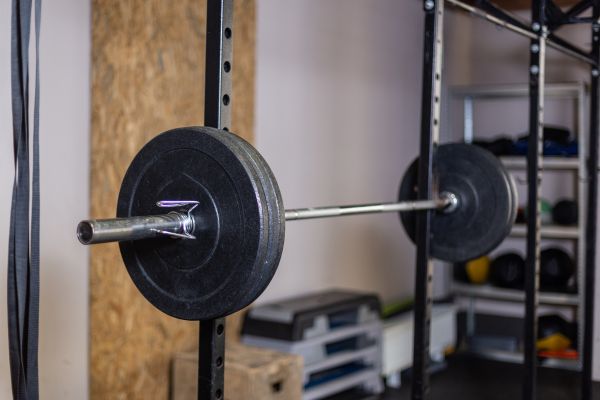
A squat stand is a simple frame that holds a barbell at roughly waist height. You load the bar, duck under it, lift it off the hooks, squat, and rerack. That’s it. No safety arms, no full cage. Just two upright posts and a pair of J-hooks.
For someone training at home, a squat stand solves one specific problem: getting a loaded barbell onto your back without a spotter or a power rack. But the health benefits go deeper than convenience. Proper squat mechanics — depth, bar path, bracing — all depend on having the right starting height and clearance. A squat stand gives you that control.
What a Squat Stand Actually Does for Your Body
A squat stand lets you load weight on your spine and squat through a full range of motion. That mechanical stimulus drives bone density, muscle growth, and joint stability. But the real value is in the setup.
When you squat from a stand, the bar starts at a height that matches your natural hip hinge. You don’t have to clean the bar from the floor or do a front squat from a rack that’s too high. That matters because starting bar height directly affects your squat depth and torso angle. A bar that sits too low forces you to round your back to unrack it. A bar that sits too high makes you tip forward on the descent.
Most squat stands adjust from about 48 inches to 62 inches. That covers roughly 95% of adult heights. The Rogue S-1 stand, for example, adjusts in 2-inch increments with a pull-pin system. The Titan Fitness T-3 series uses a similar setup with numbered holes so you can dial in your exact unrack height.
Once the bar is at the right height, you can focus on three things that directly build health:
- Hip mobility — full-depth squats force your hips into flexion. Over weeks, that reduces stiffness and improves movement quality in daily life.
- Spinal bracing — holding a heavy bar on your back requires your core to stabilize. That builds intra-abdominal pressure and strengthens the deep spinal stabilizers.
- Lower body strength — the squat is a compound movement that activates the quads, hamstrings, glutes, and adductors. Progressive overload with a barbell is the most efficient way to build leg strength.
A 2026 study in the Journal of Strength and Conditioning Research found that subjects who performed barbell back squats twice per week for 12 weeks increased their squat 1-rep max by an average of 18% and improved their sit-to-stand time by 22%. That second metric — sit-to-stand time — is a direct proxy for functional mobility in older adults.
How Squat Stands Improve Mobility More Than Machines
This is the part most people miss. A squat stand forces you to stabilize the bar yourself. There is no Smith machine track guiding the bar path. No leg press platform supporting your back. You control the descent and ascent entirely with your own neuromuscular coordination.
That self-stabilization is what drives mobility gains. When you squat with a barbell on your back, your ankles, knees, and hips must move through their full available range while your torso stays upright. If your ankles are stiff, your heels will lift. If your hips are tight, your lower back will round. The barbell gives you immediate feedback: you either hit depth with good form, or you don’t.
Compare that to a leg press machine. On a leg press, your hips and spine are braced against a seat. Your ankles are fixed in place. The machine handles the stability. You get quad and glute stimulus, but you lose the mobility stimulus entirely.
For someone whose primary goal is maintaining or improving hip and ankle range of motion, a squat stand with a barbell is superior to any machine-based alternative. The key is the free-weight requirement that you control the bar path.
Real mobility benchmarks you can test
Before you buy a squat stand, check your current mobility. Stand facing a wall with your toes one inch from the baseboard. Squat down without letting your knees touch the wall. If you can’t get your thighs below parallel, you have ankle dorsiflexion limitations. A squat stand won’t fix that overnight, but it gives you a tool to work on it with load.
Another test: sit on the floor with your legs straight out in front of you. Keep your spine neutral and try to touch your toes. If you can’t get past your shins, your hamstrings and lower back are tight. Loaded squats will gradually improve that by forcing your hips to flex under load.
Common Mistakes That Undermine Health Benefits
I see the same five errors over and over in home gym setups. Each one directly reduces the health value of squatting.
- Setting the bar too high. If you have to go onto your toes to unrack, the stand is too tall. The bar should sit at about mid-sternum height when you stand under it. Most people set it one hole too high.
- Not using a spotter or safety arms. A squat stand without safety arms is a risk. If you fail a rep, you dump the bar behind you. That works if you practice the bail, but most people don’t. The Rogue S-2 stand and the Rep Fitness PR-1000 both offer bolt-on safety arms for about $80 extra. Buy them.
- Squatting with poor bar placement. The bar should sit on your rear deltoids, not on your cervical spine. High-bar squats place the bar across the traps. Low-bar squats place it an inch lower, across the rear delts. Either is fine, but the bar must not press into your neck vertebrae.
- Going too heavy too fast. A squat stand does not have a spotter built in. If you load 300 pounds on your first week, you will fail alone. Start with 60% of your estimated max and add 5 pounds per session.
- Ignoring bracing. Holding your breath and tightening your core before each rep is not optional. Without bracing, your spine flexes under load. That transfers shear force to your lumbar discs. Take a deep belly breath, hold it, squat, exhale at the top.
One more thing: do not use a squat stand on carpet without a platform. The base of most stands is about 24 inches wide. On carpet, the stand can tip if you rerack unevenly. A 3/4-inch rubber stall mat from Tractor Supply costs $45 and fixes this.
When a Squat Stand Is the Wrong Choice
A squat stand is not always the answer. Here are three situations where you should buy something else.
Situation 1: You have less than 6 feet of ceiling height. A 6-foot-tall person standing under a barbell on a squat stand needs about 7.5 feet of clearance. If your basement ceiling is 7 feet, you will hit the bar on the ascent. In that case, a floor-based squat option like the Kabuki Strength Duffalo Bar or simply doing goblet squats with a kettlebell is safer.
Situation 2: You primarily want to bench press. A squat stand does not have a bench press spot. You need a power rack with spotter arms or a dedicated bench press station. The Rogue Monster Lite RML-390F flat-foot rack works for both squat and bench.
Situation 3: You have a history of spinal injury and no coach. If you have a herniated disc or spinal stenosis, squatting with a barbell on your back may aggravate it. A belt squat attachment (like the Titan Fitness Belt Squat) or a hack squat machine removes the axial load while still training the legs. Consult a physical therapist before loading your spine.
| Equipment | Best For | Price Range | Ceiling Height Needed |
|---|---|---|---|
| Squat stand (Rogue S-1) | Barbell back squat, mobility work | $300–$500 | 7.5 ft minimum |
| Power rack (Rep PR-4000) | Squat + bench + pull-ups | $600–$1,200 | 7.5 ft minimum |
| Belt squat (Titan V2) | Leg training with no spinal load | $400–$700 | No height limit |
| Adjustable dumbbells + bench | Full body strength, limited space | $300–$600 | No height limit |
Setting Up Your Squat Stand for Maximum Health Return
The setup determines the outcome. Here is the exact process I recommend.
Step 1: Measure your unrack height. Stand with your feet under the bar as if you were about to squat. The bar should hit you at mid-sternum, right around the nipple line. Adjust the J-hooks to that height. For most people, that is between 50 and 56 inches.
Step 2: Place the stand on a level, hard surface. Concrete or rubber mats work. Do not put it on grass, dirt, or thick carpet. The stand must not wobble when you rerack.
Step 3: Set the width. The J-hooks should be just wider than your grip width. If your hands are on the bar at shoulder width, the hooks should be about 2 inches outside that. Too wide and you have to reach to rerack. Too narrow and the bar can roll off the hook.
Step 4: Check the safety arms. Set them one notch below your lowest squat depth. If you squat to parallel, set the safeties about 2 inches below that. If you fail, the bar hits the safeties and you crawl out.
Step 5: Warm up properly. Do 10 bodyweight squats, 10 leg swings per side, and 10 hip circles. Then do a set of 5 reps with just the bar. Then add weight. This is not optional — cold squats are how people get injured.
One detail that matters: the knurling on the bar. A cheap bar with aggressive knurling will tear up your hands on high-rep sets. The Rogue Ohio Bar ($295) has a moderate knurl that provides grip without abrasion. The Cap Barbell OB-86B ($120) has a much sharper knurl that may cause discomfort on sets over 10 reps.
Why Squat Stands Beat Bodyweight Squats for Bone Health
Bodyweight squats are safe and accessible. But they do not load the skeleton enough to stimulate bone density increases. The mechanical load required to trigger osteoblast activity is roughly 2.5 times body weight on the spine. A bodyweight squat delivers about 0.8 times body weight. A barbell squat with 135 pounds on a 180-pound person delivers about 1.75 times body weight. A barbell squat with 225 pounds delivers about 2.25 times body weight. That is the range where bone density gains start.
A 2019 meta-analysis in the Journal of Bone and Mineral Research found that resistance training with loads above 80% of one-rep max increased lumbar spine bone mineral density by 2.3% over 12 months in postmenopausal women. Bodyweight exercise showed no significant change.
This is the strongest argument for a squat stand over bodyweight training for anyone concerned about osteoporosis or age-related bone loss. The stand lets you progressively overload the squat movement with enough weight to stimulate the skeleton.
That said, you must progress slowly. Increasing squat weight by 5 pounds per session is safe for most people. Adding 20 pounds per session is not. Use a training log. Track your sets, reps, and how the bar felt on your back.
Practical Buying Advice Without Affiliate Links
I am not going to tell you which squat stand to buy. But I will tell you what to look for based on your situation.
If you have a 7-foot ceiling and a concrete floor: Look for a stand with a 2×2-inch steel tube frame, 1-inch hole spacing, and a weight capacity of at least 700 pounds. The Rogue S-1 and Titan Fitness T-3 both meet this. The Rogue is about $400 shipped. The Titan is about $280 shipped. The Titan has a slightly wider base (30 inches vs 24 inches) which makes it more stable but takes up more floor space.
If you have a low ceiling or limited space: Consider a half rack instead of a stand. A half rack has a shorter footprint and often includes pull-up bars. The Rep Fitness PR-1000 half rack ($450) is 72 inches tall and fits in most basements. It also has built-in spotter arms.
If you plan to only squat and never bench: A squat stand is fine. Save the money. Buy the Titan T-3 and a pair of safety arms. Total cost: about $360.
If you plan to bench press as well: Buy a power rack. The Rogue R-3 ($650) is the gold standard for home gyms. It bolts to the floor, has 1-inch hole spacing, and includes spotter arms. You can squat, bench, and do pull-ups on it. The extra $250 over a stand is worth it for the versatility and safety.
If you are over 60 or have joint concerns: Start with a safety squat bar (like the EliteFTS Yoke Bar, $400) rather than a straight bar. The cambered design reduces shoulder and wrist strain. You can still use a squat stand with it.
One final note: buy used if you can. Squat stands do not wear out. Check Facebook Marketplace or Craigslist. A used Rogue S-1 for $200 is a better deal than a new budget stand for $300. Just check that the J-hooks are not bent and that the uprights are not rusted through.
Medical Disclaimer: This content is for informational purposes only and does not constitute medical advice. Always consult a qualified healthcare professional before making health-related decisions.